

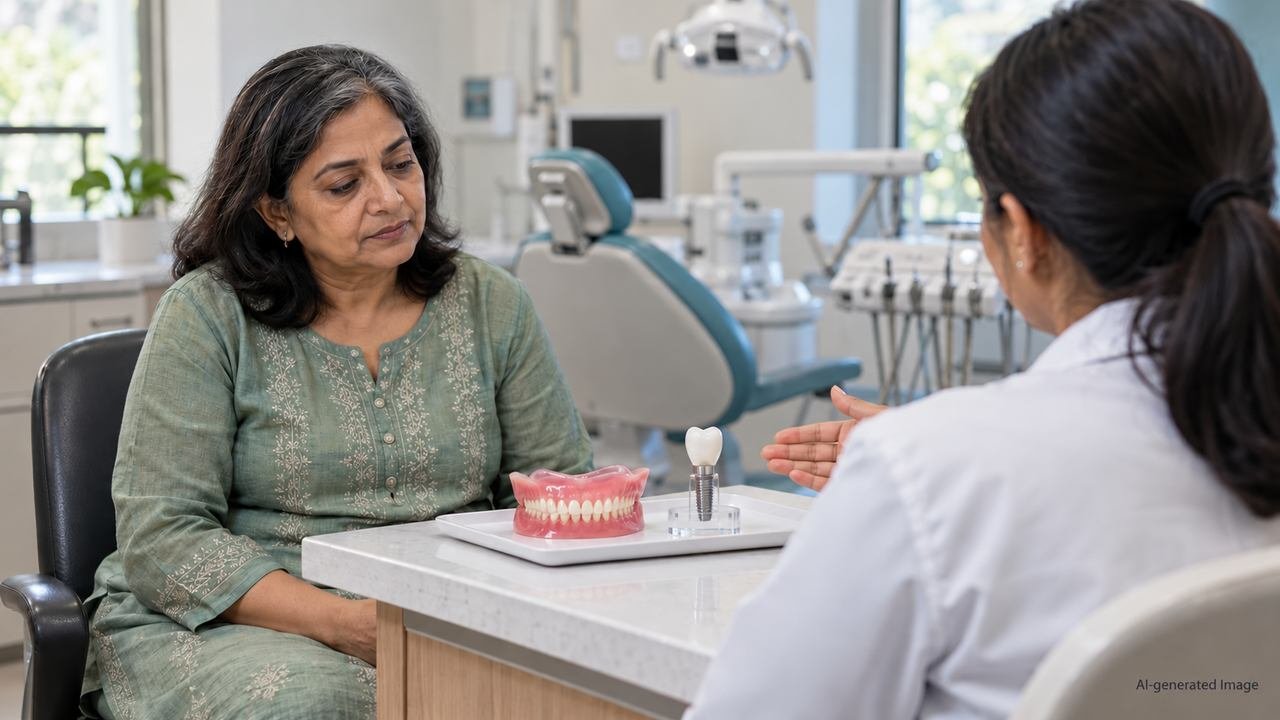
Missing teeth can affect more than your smile. They may make chewing harder, affect speech, and reduce confidence. Dental implants replace tooth roots and support fixed restorations, while dentures replace missing teeth with removable appliances.
These missing teeth replacement options differ in stability, treatment time, care and cost; the right choice depends on oral health, bone condition, the number of missing teeth and personal preferences.
To help clarify all doubts, this guide answers the topic in question in-depth to help you make informed decisions.
Why Replacing Missing Teeth is Important for Your Oral Health
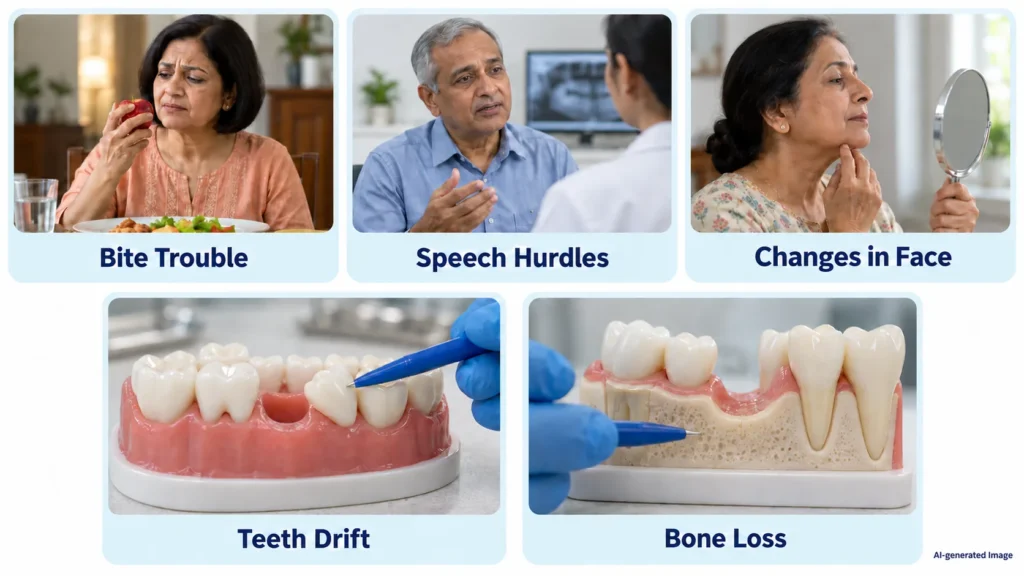
Missing teeth can affect everyday activities and the health of your remaining teeth. Suitable tooth replacement treatment can help restore oral function and appearance. Common concerns include:
- Difficulty chewing: Some foods become harder to bite and grind.
- Speech changes: Missing front teeth may affect pronunciation.
- Facial changes: Significant tooth loss and jawbone changes can affect facial support.
- Shifting teeth: Nearby teeth may move towards the gap.
- Jawbone shrinkage: Bone in the area of a missing tooth may gradually reduce.
Appropriate dental restoration treatment can help restore function and support oral health.
What Are Dental Implants and How Do They Work?
Dental implants are small posts, usually made from titanium, placed in the jawbone to act as artificial tooth roots. Once the implant integrates with the bone, you can attach a crown, bridge, or denture.
The treatment process
| Stage | What happens |
| Implant placement | The implant is positioned in the jawbone to act as an artificial tooth root. |
| Healing | The bone gradually bonds with the implant, providing stable support. |
| Restoration | A crown, bridge or denture is attached once the implant is ready. |
| Treatment suitability | Implants support fixed teeth replacement for one tooth, several teeth or a full arch without relying on neighbouring natural teeth. |
| Long-term care | Although used for permanent tooth replacement, implants are not guaranteed to last a lifetime. Good oral hygiene, regular dental reviews, healthy gums and adequate bone support are essential. Additional procedures may help patients with insufficient bone. |
What Are Dentures and When Are They Recommended?
Dentures are custom-made artificial teeth that replace missing teeth and rest on the gums. They can improve chewing, speech and smile appearance without requiring implant surgery.
Types of dentures
| Type | Description | Suitability and considerations |
| Complete dentures | Replace all teeth in the upper jaw, lower jaw or both. | Suitable for patients who have lost all teeth in an arch. |
| Partial dentures | Replace some missing teeth when natural teeth remain. | Suitable for patients who still have some natural teeth. |
| Removable dentures | Can be taken out for cleaning and maintenance. | A less invasive option, often with lower initial costs and a shorter treatment process than implants. However, they may move while eating or speaking and require an adjustment period. Changes in the gums and jawbone can also affect their fit over time. |
Dental Implants vs Dentures: What’s the Difference?
When comparing dental implants vs dentures, consider stability, maintenance, treatment time and suitability.
| Factor | Dental implants | Dentures |
| Stability | Fixed restorations are secured to implants | Conventional dentures may move |
| Feel | Can feel similar to natural teeth | May require an adjustment period |
| Maintenance | Brushing, interdental cleaning and dental reviews | Daily cleaning and fit checks |
| Treatment time | Usually takes several months | Often fitted more quickly |
| Surgery | Required for implant placement | Not required for conventional dentures |
| Initial cost | Generally higher | Generally lower |
| Suitability | Depends on bone and oral health | Suitable for many patients with missing teeth |
Neither option is automatically the best solution for missing teeth. Implants may suit patients seeking fixed restorations, while conventional dentures may suit those who prefer a removable or less invasive option.
Which Option is Better for Multiple Missing Teeth?
When several teeth are missing, the treatment plan must account for the condition of the remaining teeth, gums and jawbone.
For full mouth tooth replacement, dentists may consider several approaches.
| Treatment option | How it works |
| Complete dentures | Replace all teeth in an arch and rest on the gums |
| Implant-supported dentures | Use implants to improve denture stability |
| Fixed implant-supported bridge | Replaces multiple teeth with a restoration attached to implants |
| All-on-4 dental implants | Uses four strategically positioned implants to support a full-arch restoration in suitable patients |
Implant-supported dentures may be removable or fixed, depending on the treatment plan, bone condition and bite. All-on-4 dental implants may suit selected patients needing full-arch rehabilitation.
Factors to Consider before Choosing Dental Implants or Dentures
The right solution for missing teeth depends on more than appearance. A dentist will assess these factors before recommending dental restoration treatment.
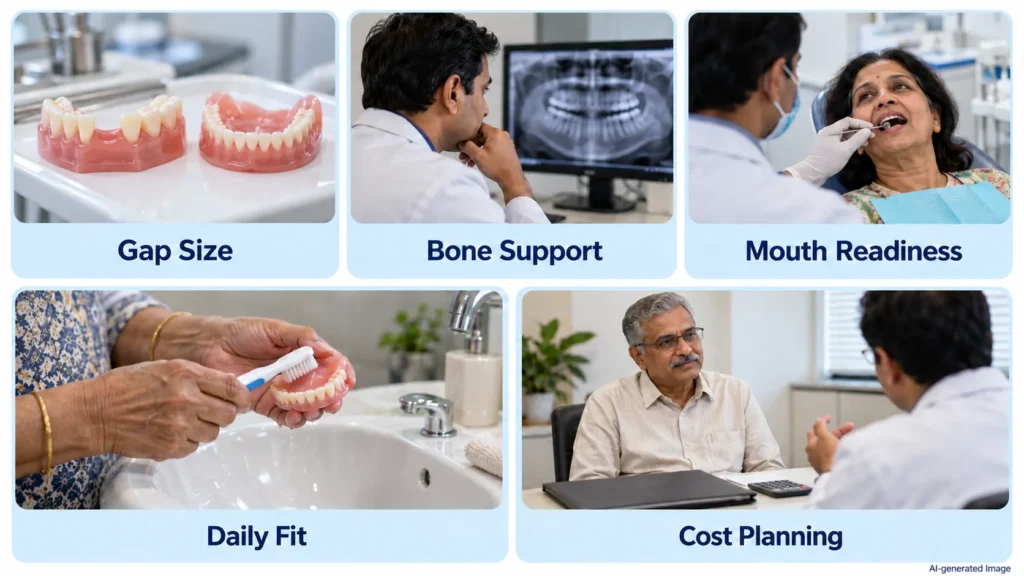
- Number of missing teeth: Replacing one tooth differs from restoring an entire arch.
- Jawbone condition: Implants need adequate bone support; grafting may sometimes be considered.
- Oral health: Gum disease and untreated decay may need treatment first.
- Lifestyle: Consider whether fixed teeth or removable dentures better suit your routine.
- Budget: Compare initial costs with future maintenance, adjustments and replacement needs.
Your ability to maintain oral hygiene and attend follow-up appointments also matters. A personalised assessment helps balance function, appearance and long-term care.
Are Dental Implants Worth the Investment?
Dental implants may be worth considering if you want a stable restoration that supports comfortable chewing and a natural-looking smile. They can also help maintain bone around the implant site through functional loading.
However, implants involve surgery, a longer treatment timeline and a higher initial cost than conventional dentures in many cases. Long-term success depends on healing, oral hygiene, gum health, and professional care.
Can Dentures Be a Comfortable Option?
Yes. Modern dentures can provide a comfortable, natural-looking replacement when properly designed and fitted.
How to maintain denture comfort
- Clean dentures daily with a suitable cleanser.
- Brush the gums, tongue and remaining natural teeth.
- Remove dentures at night unless advised otherwise.
- Attend regular dental reviews to check the fit.
- Seek adjustments if dentures cause soreness or slip frequently.
Some initial soreness or difficulty speaking is possible, but adjustments can improve comfort. Implant-supported options may offer greater stability for patients who struggle with loose conventional dentures.
Why Consult a Dentist before Choosing between Dentures and Dental Implants?
Online comparisons can't determine whether a treatment suits your mouth. A dental examination helps assess the remaining teeth, gums, bite and jawbone. X-rays or scans may also be needed to plan implant placement.
We assess your dental condition and discuss suitable treatment options, expected timelines, potential risks and costs. If you are considering dental implant treatment in Kolkata, a consultation can help you understand whether implants, dentures, or an implant-supported restoration best matches your needs.
Restore Your Smile with the Right Choice
Missing teeth should not stop you from enjoying your favourite foods or smiling confidently. Both dental implants and dentures can restore function and appearance, but the right choice depends on your oral health, budget and expectations. For personalised advice on how to get a dental implant done, book a consultation to explore suitable tooth replacement options.
What People Also Ask
1. Are dental implants better than dentures for missing teeth?
Implants provide stable support for fixed teeth, while conventional dentures offer a removable, less invasive option. Suitability depends on oral health, bone support, budget and personal preferences.
2. How do you know whether you need dental implants or dentures?
A dentist assesses the number of missing teeth, gum health, jawbone condition and treatment goals. X-rays or scans may be required before recommending an option.
3. Can dentures replace all missing teeth permanently?
Complete dentures can replace all teeth in an arch, but they are removable and may need adjustments or replacement as the mouth changes.
4. How long do dental implants and dentures usually last?
Both can last for many years with proper care. Implants may need restoration replacement, while dentures may require relining or replacement as their fit changes.
5. Are dental implants suitable for senior citizens with missing teeth?
Yes, many older adults can receive implants. Bone health, gum condition, general health, healing capacity, and oral hygiene matter more than age alone.